


Bowed basement walls are a common structural problem in homes with concrete block or poured concrete foundations. Over time, pressure from the surrounding soil can push against the foundation walls, causing them to crack and gradually move inward.
If left untreated, bowed walls can continue to worsen as soil pressure increases, potentially leading to serious structural damage. The good news is that several proven repair methods exist to stabilize foundation walls and prevent further movement.
This guide explains what causes bowed basement walls, how to recognize the warning signs, and the most effective repair methods used today to stabilize and reinforce failing foundation walls.

This Guide Explains:
-
What causes bowed basement walls
-
Warning signs to watch for
-
Common repair options
-
Modern carbon fiber stabilization systems
What Causes Bowed Basement Walls?
Bowed basement walls are a common structural problem in homes with concrete block or poured concrete foundations. Over time, pressure from the surrounding soil can push against the foundation walls, causing them to crack and gradually move inward.
If left untreated, bowed walls can continue to worsen as soil pressure increases, potentially leading to serious structural damage. The good news is that several proven repair methods exist to stabilize foundation walls and prevent further movement.
This guide explains what causes bowed basement walls, how to recognize the warning signs, and the most effective repair methods used today to stabilize and reinforce failing foundation walls.


Common causes include:
Expansive Soil Pressure
Clay soils expand when they absorb water and shrink as they dry. This repeated expansion and contraction places significant stress on foundation walls.
Poor Drainage Around the Foundation
Improper grading, clogged gutters, or excessive groundwater can lead to hydrostatic pressure that pushes against basement walls.
Freeze-Thaw Cycles
In colder climates, soil expansion during freeze-thaw cycles can increase pressure on foundation walls and gradually push them inward.
Construction or Structural Limitations
Some older homes were built with foundation walls that were not designed to resist long-term soil pressure, particularly concrete block foundations.
When these forces build up over time, the wall may begin to crack and bow inward.
Signs Your Basement Wall Is Bowing
Bowed basement walls rarely happen suddenly. In most cases the movement occurs gradually as pressure builds against the outside of the foundation.
Early detection is important because stabilizing the wall before movement becomes severe can prevent more costly structural repairs.
Common warning signs include:
-
Horizontal cracks running across foundation walls
-
Stair-step cracks in block foundation mortar joints
-
A noticeable inward curve along the wall
-
Water entering through cracks in the wall
-
Basement windows or doors becoming difficult to open
-
Separation between the wall and floor framing above
If these symptoms are present, the wall should be evaluated to determine the appropriate stabilization method.

How Much Bowing Is Too Much?
The severity of a bowed basement wall is measured by the amount of inward movement, or deflection, along the wall. This helps determine the most appropriate stabilization method.
Less than 1 inch of bowing
Minor wall movement may be present. Structural reinforcement can often stabilize the wall and prevent further movement.
1 to 2 inches of bowing
Moderate structural movement is present. Carbon fiber stabilization systems are commonly used to reinforce the wall and resist additional soil pressure.
More than 2 inches of bowing
Greater wall movement may indicate higher structural stress. In these cases, engineered stabilization methods such as modified strap spacing, tiebacks, or additional reinforcement may be used depending on the wall condition.
Carbon fiber systems like BowGuard are commonly installed when walls exhibit inward bowing and cracking caused by flexural bending. These systems are designed to stabilize bowed basement walls and prevent further inward movement, rather than straighten the wall.
How Bowed Basement Walls Are Repaired?
Several proven methods are used to stabilize bowed basement walls. The right repair solution depends on the severity of the movement, the type of foundation wall, and site conditions around the home.
The most common repair methods include carbon fiber reinforcement, wall anchor systems, and structural steel beam reinforcement.

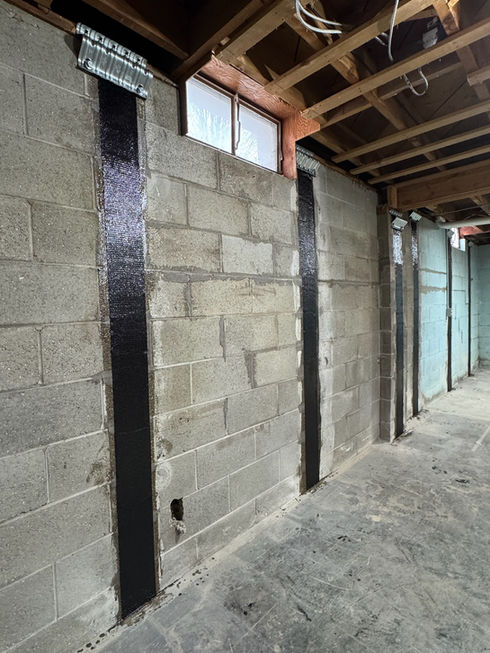
Carbon Fiber Bowed Wall Reinforcement
Carbon fiber reinforcement has become one of the most effective solutions for stabilizing bowed basement walls. These systems use high-strength carbon fiber straps bonded to the wall with structural epoxy to reinforce the foundation and resist further inward movement.
Once cured, the carbon fiber forms a strong composite reinforcement layer that helps counteract the lateral soil pressure pushing against the wall.
Carbon fiber stabilization systems are widely used because they:
-
Provide extremely high tensile strength
-
Require minimal interior space
-
Do not require exterior excavation
-
Install quickly with minimal disruption
-
Provide long-term structural reinforcement
Because carbon fiber straps are thin yet extremely strong, they can reinforce foundation walls without significantly reducing usable basement space.
Modern systems are designed to stabilize walls
showing signs of flexural bowing and horizontal cracking, helping prevent additional movement caused by soil pressure.
The BowGuard Bowed Wall Stabilization System
The BowGuard Stabilization System, developed by Structural Reinforcement Solutions (SRS), is an advanced carbon fiber reinforcement system designed to stabilize bowed basement walls subjected to lateral soil pressure.
The system uses SRS-600 unidirectional carbon fiber straps combined with structural epoxy and engineered anchorage components to reinforce the wall from top to bottom.
Unlike many basic carbon fiber strap systems that rely only on surface bonding, BowGuard creates a continuous structural load path from the house framing to beneath the basement slab.
This top-to-bottom reinforcement helps transfer structural forces away from the wall and into the surrounding structure, providing stronger stabilization against inward movement.
The BowGuard system combines several engineered components:
-
SRS-600 Unidirectional Carbon Fiber Straps for high tensile reinforcement
-
SRS-1000 Structural Epoxy to bond the carbon fiber to the foundation wall
-
SRS-2100 Rapid-Cure Structural Paste to repair cracks and hinge points
-
Simpson Strong-Tie® URFP Retrofit Foundation Bracket to anchor the system to the sill plate
-
Slab-Lock termination beneath the basement floor to secure the base of the reinforcement
Together, these components create a continuous reinforcement system designed to stabilize bowed foundation walls and prevent further inward movement caused by soil pressure.


How the BowGuard System Works
The BowGuard bowed wall stabilization system reinforces foundation walls using high-strength carbon fiber straps bonded to the wall with structural epoxy and anchored at both the top and bottom of the foundation.
Once installed, the system creates a continuous reinforcement path from the sill plate to beneath the basement slab, helping transfer structural forces away from the wall and resist additional inward movement caused by soil pressure.

Typical Installation Process
-
Wall Preparation
The wall surface is cleaned and prepared to ensure proper bonding of the carbon fiber reinforcement system. -
Crack and Hinge Point Repair
Existing cracks or hinge points in the wall are filled using structural repair paste to restore surface continuity. -
Carbon Fiber Strap Installation
High-strength SRS-600 unidirectional carbon fiber straps are bonded vertically to the wall using structural epoxy. -
Top Anchorage at the Sill Plate
The system is mechanically connected to the structure above using the Simpson Strong-Tie® URFP retrofit foundation bracket, creating a secure top connection. -
Slab-Lock Bottom Termination
The base of the carbon fiber strap is anchored beneath the basement slab to secure the reinforcement system and complete the structural load path.
Once cured, the carbon fiber reinforcement system forms a strong composite structure designed to stabilize bowed basement walls and prevent additional inward movement.
Why Carbon Fiber Is Often Preferred for Bowed Wall Repair
Carbon fiber reinforcement systems have become one of the most widely used methods for stabilizing bowed basement walls because they provide extremely high tensile strength while requiring minimal space.
Compared to traditional structural repair methods, carbon fiber systems offer several advantages:
-
Minimal loss of interior basement space
-
No exterior excavation required
-
Fast installation with minimal disruption
-
Extremely high tensile strength
-
Long-term structural reinforcement
Because the reinforcement straps are thin but extremely strong, they can stabilize foundation walls without significantly affecting usable basement space.
When Should a Bowed Basement Wall Be Repaired?
Bowed basement walls rarely repair themselves. In most cases, the inward movement gradually increases as soil pressure continues to build against the foundation.
Addressing the issue early can help prevent additional structural damage and more complex foundation repairs.
If a basement wall shows signs of inward bowing, horizontal cracking, or separation from the floor framing, a stabilization system may be recommended to prevent further movement.
Request a Bowed Wall Repair Plan
If you're dealing with a bowed basement wall, the first step is understanding the severity of the movement and the best repair option for your situation.
Structural Reinforcement Solutions can review photos of your wall and help determine whether a carbon fiber stabilization system like BowGuard may be appropriate for the repair.
Submit photos of your wall and a brief description of the issue to receive a recommended stabilization approach and product guidance.
Frequently Asked Questions
Can carbon fiber fix bowed basement walls?
Carbon fiber reinforcement systems can stabilize many bowed basement walls by strengthening the wall and preventing further inward movement caused by soil pressure.
Will carbon fiber straps straighten a bowed wall?
Most carbon fiber systems are designed to stabilize the wall and prevent further movement rather than push the wall back to its original position.
How much bowing can carbon fiber repair?
Carbon fiber stabilization is commonly used for walls with moderate inward movement, though more severe cases may require engineered reinforcement spacing or additional stabilization methods.
Is carbon fiber foundation repair permanent?
When properly installed using structural epoxy and proper anchorage, carbon fiber reinforcement systems provide long-term stabilization for bowed foundation walls.
Technical Data


Case Studies


Product Flyer
Installation Instructions


Why Choose SRS?
We are the carbon fiber infrastructure rehabilitation experts. SRS proudly leads the way with American Made carbon fiber strengthening systems that are built around the needs of professionals, designed, and engineered to preserve concrete structural components.

A Client Experience You Can Rely On
Our expert in-house engineers and dedicated support team are committed to providing an unparalleled customer experience. With an extensive carbon fiber inventory and same day shipping, SRS has the materials and expertise you can count on.
• Engineered Carbon Fiber Designs
• Same Day Support
• Contractor Training
• Commercial Format Roll Kits
25-Year Structural Warranty
Clear, Transferable, and Backed by Real Engineering

Unlike "lifetime warranties" that rely on vague definitions of a structure’s lifespan, SRS provides a straight forward 25-year structural warranty for BowGuard carbon fiber installations. This gives homeowners and inspectors confidence in what is covered—with no ambiguity or hidden fine print.
Our 25-year warranty offers:
• Defined, predictable coverage for 25 years
• Full transferability to future homeowners
• Protection based on documented installation practices
• A warranty grounded in real engineering—not marketing language
A warranty only matters if it is clear and enforceable. BowGuard delivers 25 years of transparent protection, backed by high-performance carbon fiber and installation standards that ensure long-term stability.