


How Carbon Fiber Works For Column Repair
Concrete column repair begins with evaluating the cause and extent of the damage. Loose or deteriorated concrete is removed, exposed reinforcing steel is cleaned and treated as required, and compatible structural repair materials are used to restore the column’s original profile.
Once the substrate has been repaired and properly prepared, an engineered carbon fiber-reinforced polymer system can be installed around the column. The bonded carbon fiber wrap provides confinement and may increase shear, axial, or flexural capacity depending on the reinforcement design.
SRS-660BI Directional carbon fiber is commonly used for column confinement because it provides reinforcement in two directions. When additional strengthening is required, SRS-600UNI Directional carbon fiber may be incorporated in the orientation and number of layers specified by the engineer.
The result is a lightweight, low-profile strengthening system that can restore or increase structural capacity without the disruption and added weight associated with many conventional repair methods.

Engineered Reinforcement for Different Column Conditions
No single carbon fiber layout is appropriate for every column. The required fabric, fiber orientation, bonded length, number of layers, and anchorage details depend on the column geometry, existing reinforcement, substrate condition, loading, and capacity that must be restored or added.
SRS-660BI may be specified for confinement and multidirectional reinforcement. When greater capacity is required in a particular direction, engineered layers of SRS-600UNI can be incorporated into the strengthening system.
After the carbon fiber system has cured, a compatible protective or architectural coating can be applied when required. The completed repair can be finished to blend with the surrounding structure while protecting the reinforced column from environmental exposure.


Why Concrete Columns Deteriorate and Fail
Concrete columns are essential structural components that bear loads and provide stability in buildings and infrastructures. Despite their critical role, concrete columns can fail due to various factors. Understanding these failure modes is crucial for preventing structural damage and ensuring safety.
Buckling occurs when a column deforms or bends under compressive forces, leading to a sudden sideways failure.
Compression failure happens when the material of the column is crushed under excessive load.
Shear failure occurs when the column's material fails along a plane due to shear stresses, causing a sliding failure.
Shear cracks appear as diagonal (≈45°) fractures caused by high lateral or shear stress that exceeds the concrete’s tensile strength or the capacity of internal steel ties (stirrups). Unlike vertical compression cracks, shear cracks form suddenly and indicate a serious loss of load-carrying capacity. They’re most often seen in short columns, seismic zones, or corroded structures where stirrups have weakened. Prompt inspection is critical, as shear failure can be rapid and catastrophic.
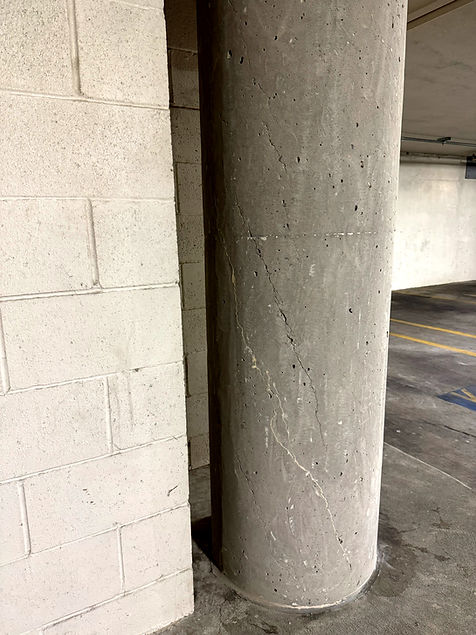

Diagonal cracking may indicate a serious shear deficiency and should be evaluated promptly by a qualified engineer.

Strengthening Fire-Damaged Columns
Fire and extreme heat can reduce the strength of concrete, reinforcing steel, and other structural materials. Rapid heating and cooling may cause cracking, spalling, loss of bond, and changes to the properties of the internal reinforcement.
Before a fire-damaged column is repaired, the extent of the damage and the remaining structural capacity must be evaluated. Unsound concrete may need to be removed, damaged reinforcement addressed, and the column profile restored before strengthening begins.
When specified as part of an engineered repair, carbon fiber reinforcement can help restore required capacity and confine the repaired column. If future fire exposure is a design consideration, the completed CFRP system may also require an approved fire-protection assembly or coating.


