
How South Carolina DOT Repaired Six Timber Bridge Piles With Carbon Fiber
With preparation completed in advance, a three-person South Carolina DOT crew installed carbon fiber reinforcement and applied the protective coating to six timber bridge piles in a single workday, with on-site guidance from Structural Reinforcement Solutions (SRS). Careful planning, concrete work, crack injection, pile preparation, and staging were completed beforehand, allowing the crew to move smoothly through the wrapping and coating process.
At the bridge site in Gresham, South Carolina, recurring water exposure through openings in the deck had contributed to splits and voids in six wood piles. Swampy terrain and limited access made replacement beneath the structure difficult.

Timber bridge pile repair for DOT and public works teams
For DOT bridge maintenance departments, county engineers, and municipal public works teams, this project demonstrates an in-place repair approach for existing supports where replacement access is difficult. The repair combined concrete encasements on the lower pile sections with epoxy repairs and bonded carbon fiber reinforcement on the upper exposed timber.
The site: access beneath the bridge
Developing the repair with South Carolina DOT
An SCDOT Resident Bridge Maintenance Engineer provided pile photographs, dimensions, and lower-pile encasement details to an in-house engineer at Structural Reinforcement Solutions. Together, they refined the wrap height, reinforcement layout, material quantities, and coating selection for the timber bridge pile repair.
SRS helped plan access, supplied an equipment checklist, and provided hands-on installation training. An SRS technical services representative worked alongside the SCDOT crew on site, providing guidance through each stage of the repair.
Watch the SCDOT timber pile repair process
Follow the crew from split repairs and material preparation through carbon fiber wrapping and the Marine Shield finish. Select a thumbnail to watch each stage.

1. Bridge and work platforms


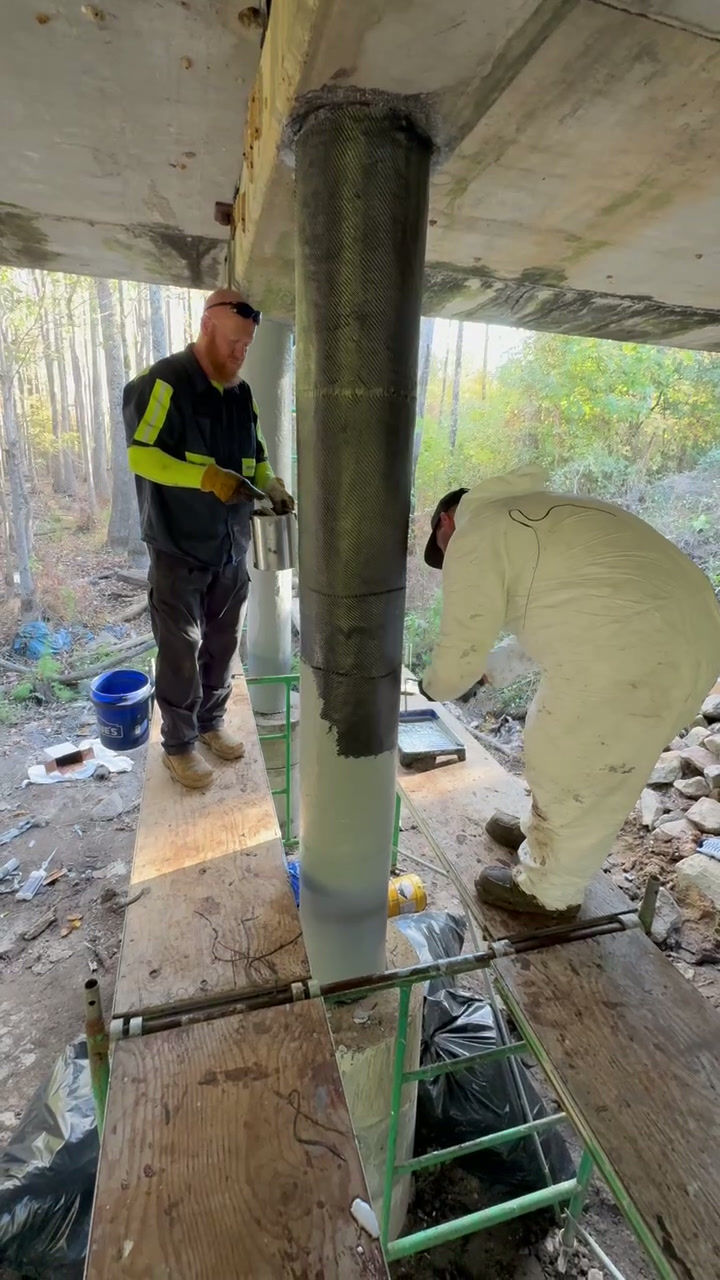
Step 1: Evaluate the wood piles and prepare access
Before choosing a repair, the project team needs to understand the remaining timber, split depths, section loss, exposed pile height, water exposure, and access constraints. Internal deterioration and foundation conditions also affect whether a pile is suitable for rehabilitation.
SCDOT arranged scaffolding and work platforms before the field training. A polyethylene-covered work surface beside the bridge provided an organized area for measuring, cutting, and saturating the fabric.
Step 2: Fill larger splits and restore the surface
The crew cleaned the timber and filled larger splits and voids with SRS-2000 Structural Repair Paste. The material was worked into the damaged areas and smoothed to restore the local surface profile.
This preparation helped the fabric follow the timber surface rather than bridge across open gaps. Unexpected deeper deterioration would require review before wrapping continued.
Step 3: Profile the bonding surface
Smaller irregularities were addressed with SRS-1000 Structural Epoxy Adhesive thickened with SRS-specified mini fibers. The profiling layer created a more continuous surface for contact with the carbon fiber. The crew followed the project’s material instructions while preparing the surface for the wet-layup installation.
Step 4: Cut and saturate the carbon fiber
The crew measured and cut SRS-660BI Bidirectional Carbon Fiber Fabric to the required lengths. Each section was saturated with SRS-1000 Structural Epoxy Adhesive on the covered work surface before being carried to the pile.
Organizing the cutting and saturation area allowed the crew to coordinate material preparation with installation beneath the bridge. Manageable sections helped keep the wet fabric ready for placement within the resin’s working time.
Step 5: Wrap the piles from the top downward
Before placing the saturated fabric, the crew rolled SRS-1000 Structural Epoxy Adhesive onto the prepared wood pile. The saturated fabric was installed around the prepared timber, beginning at the top and progressing downward working the fabric to conform to the pile. For this repair, wrap overlaps, fiber orientation, layer count, and terminations were established in the project-specific reinforcement layout.
Step 6: Apply the protective coating
SRS-6100 Marine Shield, a two-part epoxy protective coating reinforced with Kevlar, was applied over the carbon fiber wrap. Selected for its bond to carbon fiber and suitability for use above or below the waterline, the coating provides long-term protection against UV and harsh environmental exposure.

A Repair Option for DOT and Public Works Teams
For DOT bridge maintenance departments, county engineers, and municipal public works teams, this SCDOT project shows how existing timber supports can be repaired in place where replacement access is difficult. Assessing pile condition and coordinating engineering details, materials, access, and crew training helps determine whether a similar approach fits another bridge.

Planning a wood pile repair?
Structural Reinforcement Solutions works with engineers, DOT maintenance departments, and public works teams on material selection, project-specific repair planning, and installation training.
Explore SRS wood pile repair and strengthening applications for more on repair options for existing timber supports.
For an initial review, provide pile photographs, dimensions, inspection findings, lower-pile encasement details, and information about access and water levels. These details help the team assess the repair approach and the next steps.
Start with SRS’s project review form.
Explore another infrastructure repair: How to Repair Light Pole Foundations Without Replacement.


Comments